Written by Cleo Team
In Publication
On July 22, 2025
Agentic reasoning, personalized memory, and real-time voice. Cleo's smartest upgrade yet.

Today, we’re introducing Cleo 3.0, the biggest leap yet for the world’s first AI financial assistant.
Cleo 3.0 makes conversations about money smarter and more personal. Powered by advanced adaptive reasoning, proactive data-driven insights, and real-time voice, Cleo now anticipates your needs to deliver financial coaching that feels genuinely human. This is Cleo at the most capable she’s ever been: more helpful, more intuitive, and more deeply attuned to how real people relate to their money.
Cleo 3.0 doesn’t just understand what you said. She figures out how to get it done.
Cleo 3.0 transforms how you experience financial coaching with major upgrades across the board, including stronger reasoning, deeper personalization, and entirely new ways to interact.
Agentic architecture. Cleo now dynamically handles multi-step tasks directly in chat, using a fully agentic approach that autonomously selects tools and reasons through each step.
Proactive reasoning. Using OpenAI’s advanced o3 model, Cleo now analyzes recent transaction history with chain-of-thought reasoning to provide deeper, more relevant insights about your financial habits—without waiting for you to ask.
Memory. Cleo remembers key details from your previous chats, like budgeting goals and financial stressors, to create personalized, continuous interactions that feel human and familiar.
Voice. You can now talk naturally with Cleo through real-time, two-way voice conversations and play voice-driven financial trivia games.
To measure how Cleo 3.0 stacks up, we put her head-to-head with leading LLMs from OpenAI, Anthropic, and Google.
Our evaluations used data from 129 genuine transactions, representing approximately $29,500 in inflows and $29,900 in outflows. Benchmark questions covered practical, high-trust budgeting queries, like calculating monthly income vs. expenses and identifying a user’s most expensive subscription. Cleo 3.0 achieved an accuracy rate of 81%, decisively outperforming the rest of the field.
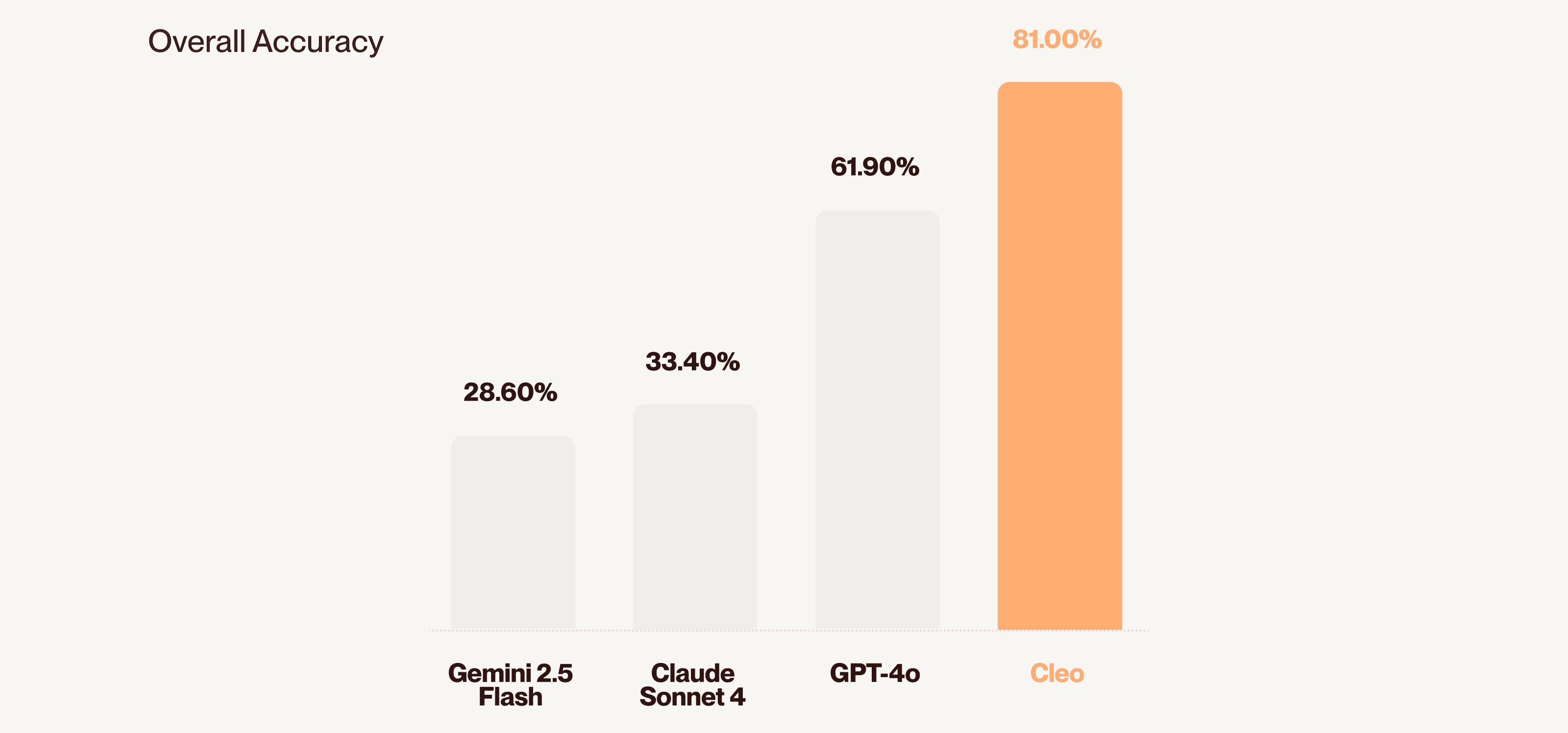
Cleo significantly outperformed competitor models on our financial benchmark.
The difference comes down to Cleo’s architecture, which is purpose-built for handling financial data. For precise tasks like filtering transactions and performing calculations, Cleo uses deterministic tools to do the actual math, while the LLM layer interprets user requests and generates responses. By design, this eliminates a major source of hallucinations and delivers more accurate, trustworthy answers where it matters most.
Cleo 3.0 introduces an AI assistant that doesn’t just understand what you said, but figures out how to get it done. And she can adapt to the task at hand, thinking harder when the problem is complex and responding faster when it isn’t.
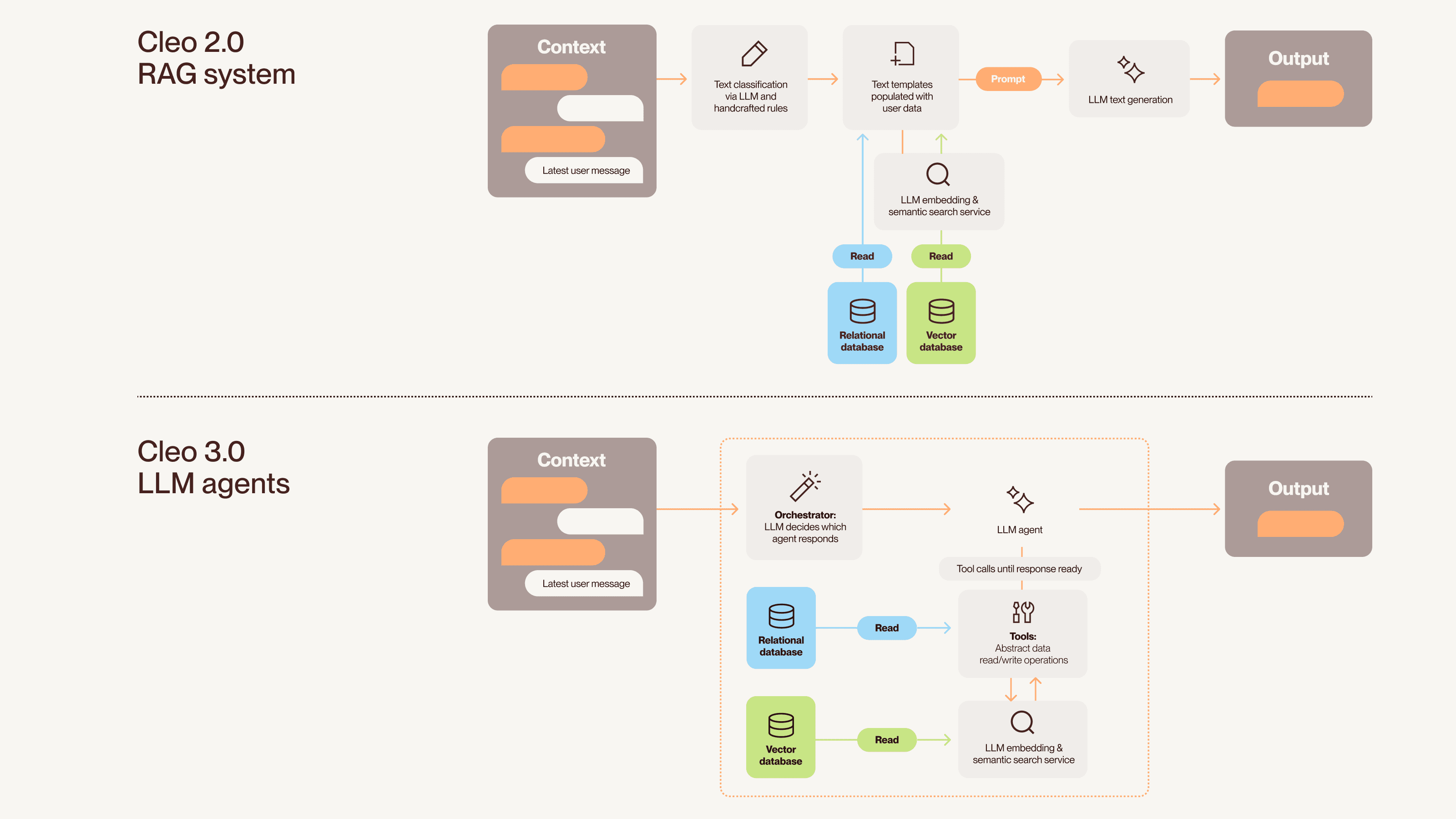
Previously, conversations with Cleo followed a fixed pipeline: first classifying intent, then generating a response. Even simple tasks required predefined flows. If a user asked to set a budget, for example, they’d be pushed out of the conversation to complete it manually, with no way for Cleo to reason through the process or adapt to follow-ups.
Now, Cleo’s reasoning agent interprets the request, chooses the right tools, evaluates the results, and loops until the task is finished. Some interactions are simple, comprising a single tool call with a clear response. Others require multiple coordinated steps—for example, confirming earned wage access eligibility and helping you subscribe to Cleo Pro, or assisting with repayment and prompting you to enter a new payment method if needed.
Cleo 3.0 doesn’t just wait for questions; she reasons proactively about your finances. A new system called the Smart Insights Agent, which uses OpenAI’s o3, reviews your transaction history and surfaces timely, actionable insights without needing to be prompted.
The agent analyzes the past six months of financial activity, enriched with details like merchant names, spending categories, and social comparison signals. It uses multi-step reasoning to make multiple passes over the data, refining its understanding as it goes. This lets Cleo detect subtle or emerging patterns, like growing repayment burdens or unexpected shifts in savings behavior, and generate structured insights tagged by category and confidence level. Because this reasoning happens in the background, Cleo can surface personalized insights the moment you open the app.
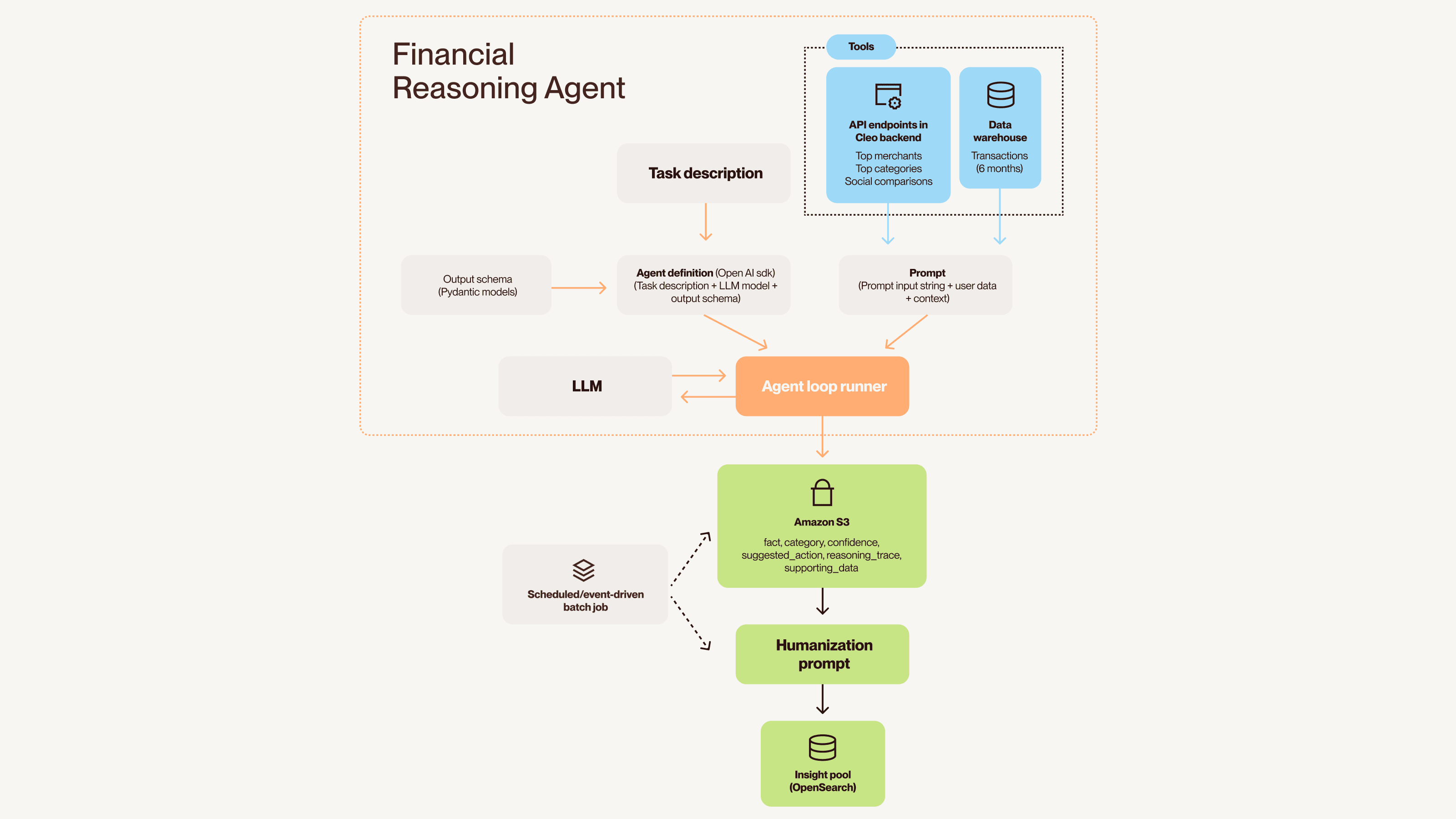
Diagram showing proactive financial reasoning over a user’s transactions, using an agent framework with OpenAI’s o3 model to create a pool of insights that are loaded into a vector database (OpenSearch).
Cleo’s new agentic architecture adapts in real time, choosing the right tools and responding flexibly to user needs.
Cleo 3.0 uses a growing library of around 40 tools to handle user requests by retrieving information, taking action, and coordinating across systems to complete tasks. Each tool is defined with structured instructions that tell the model when to use it, what inputs to provide, and how to interpret the results. And because Cleo can reason about which tools to use and in what order, she can carry out even multi-step tasks with minimal back-and-forth.
Broadly speaking, Cleo’s tools fall into two categories: retrieval and action. Retrieval tools help her answer questions by pulling data from databases or searching internal knowledge bases. For example, if you ask how much you have left to spend, Cleo looks up your budget in real time.
Action tools, on the other hand, let Cleo do things for you. In previous Cleo versions, actions relied on predefined buttons built with manual rules. In Cleo 3.0, the agent configures those actions dynamically, choosing what’s needed based on the conversation itself. Whether that means setting up a new budget or escalating a support issue, Cleo makes the interaction feel fluid and adaptive, not scripted.
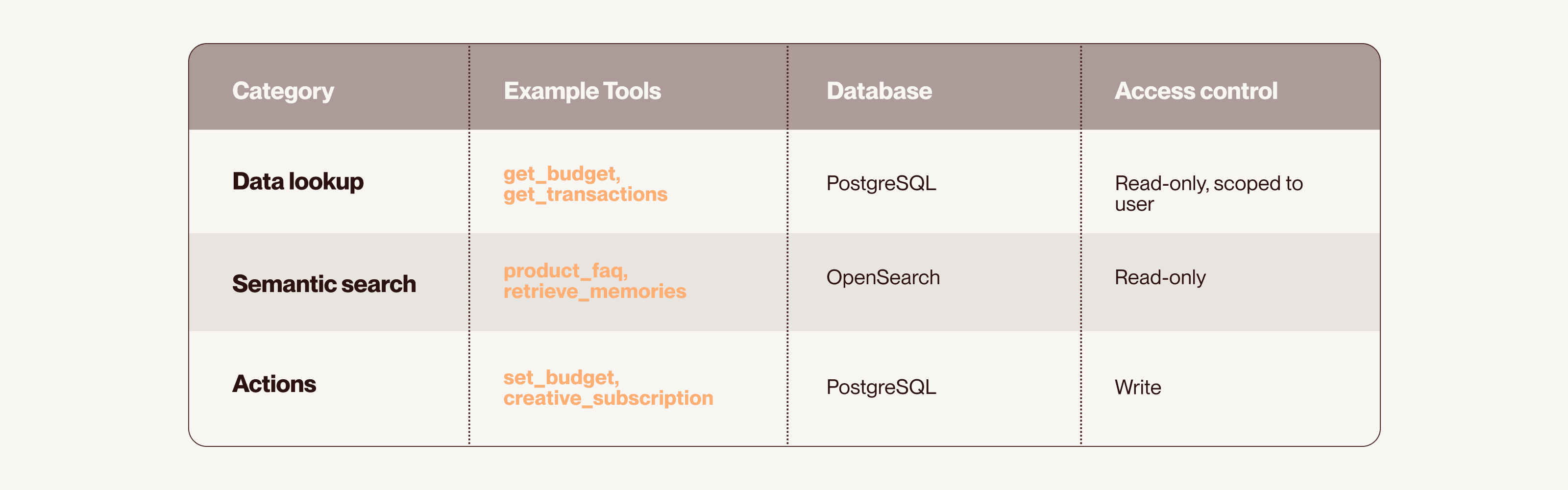
Examples of Cleo’s internal tools, grouped by function, data source, and access type.
Forgetfulness undermines trust. You shouldn’t have to repeatedly tell Cleo the same information, and your chats with her shouldn’t feel disconnected. Cleo 3.0 directly addresses this by introducing conversational memory. Now, each conversation builds naturally on the last for deeper, more personalized financial assistance.
Cleo 3.0 can summarize and store conversations, capturing details such as budgeting goals, recurring spending patterns, and financial stress points. Rather than storing every word, Cleo preserves the key takeaways and retrieves relevant context when it matters most. By proactively recalling previous conversations, Cleo provides advice that feels genuinely human, supportive, and context-aware, significantly reducing the need for repetitive prompting.
Talking to Cleo 3.0 is like chatting with a friend who knows your financial story inside and out. Instead of typing questions, you can just talk to Cleo, and she’ll respond in kind.
Behind the scenes, this is powered by a two-way pipeline integrating speech-to-text and text-to-speech technology. When the user speaks, their voice is instantly transcribed into text, which the LLM processes to determine the appropriate response. That response is then converted into spoken audio through text-to-speech synthesis and streamed directly back to the user, maintaining minimal latency and a natural conversational flow. We’ve also introduced a dynamic visual representation of Cleo that actively responds as she listens and speaks, enhancing the feeling of real-time interaction.
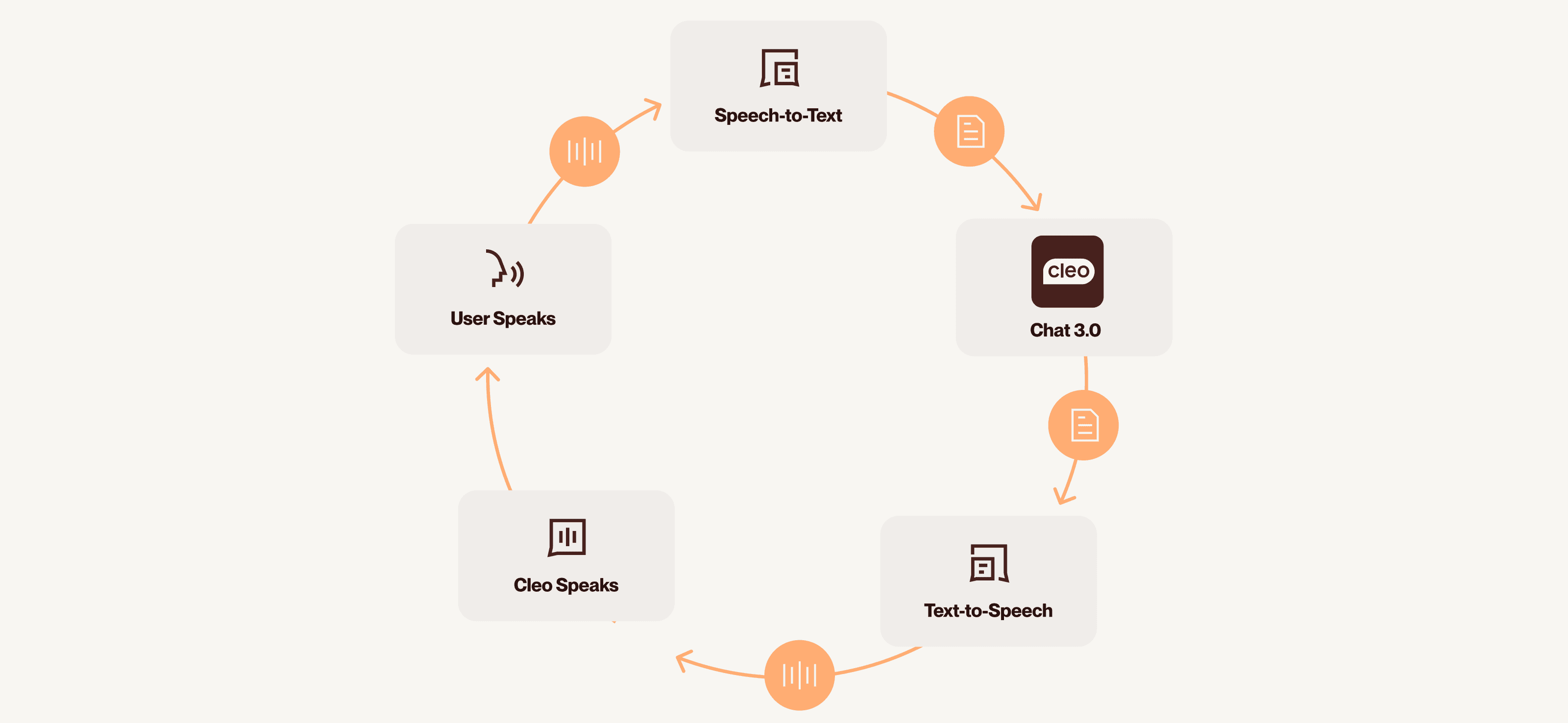
Speech-to-text and text-to-speech enable real-time conversations with Cleo.
Cleo 3.0’s voice capabilities also go beyond immediate conversations. Voice mode brings new energy to gamified features like financial trivia, where Cleo guides you through playful, data-driven challenges designed to deepen your understanding of your finances.
All AI-powered features in Cleo 3.0 are available exclusively to Pro subscribers:
Reasoning, including full access to Smart Insights, the ability to follow up directly in chat, and the option to toggle between OpenAI’s o3 and GPT‑4o models.
Memory, including automatic summarization and recall of key details from past chats.
Voice, including real-time voice chat and interactive audio features like financial trivia.
Cleo 3.0 sets a new standard for AI in personal finance, but there’s still plenty to explore. In future versions, we’re planning to deepen Cleo’s understanding of users’ financial lives and expand what she can do to support them.
We’re continuing to learn and iterate quickly. Upcoming features we’re especially excited about include:
Finhealth score, a composite metric that reflects a user’s overall financial behavior and progress, designed to drive engagement, goal setting, and long-term improvement.
Visualizations in chat, with graphs and trendlines rendered directly in conversation so users can understand spending patterns without leaving the chat.
Account aggregation, enabling users to connect multiple financial accounts so Cleo can reason across income streams and deliver cross-account insights.
These directions reflect where Cleo is headed: combining deeper reasoning with more flexible tool use, tighter integration across accounts, and more natural, voice-led interactions. With these updates, we’re creating an AI financial partner that meets you where you are and helps you grow into a better relationship with your money.